
NVIDIA has spent years making PC games run faster.
Now, the company is trying to change something much bigger: how games actually look.
That is the real story behind NVIDIA DLSS 5.
DLSS started as a way to use artificial intelligence to reconstruct a higher-resolution image from a lower-resolution render. Over time, NVIDIA expanded the technology with Super Resolution, Frame Generation and Ray Reconstruction.
But DLSS 5 moves into a different territory.
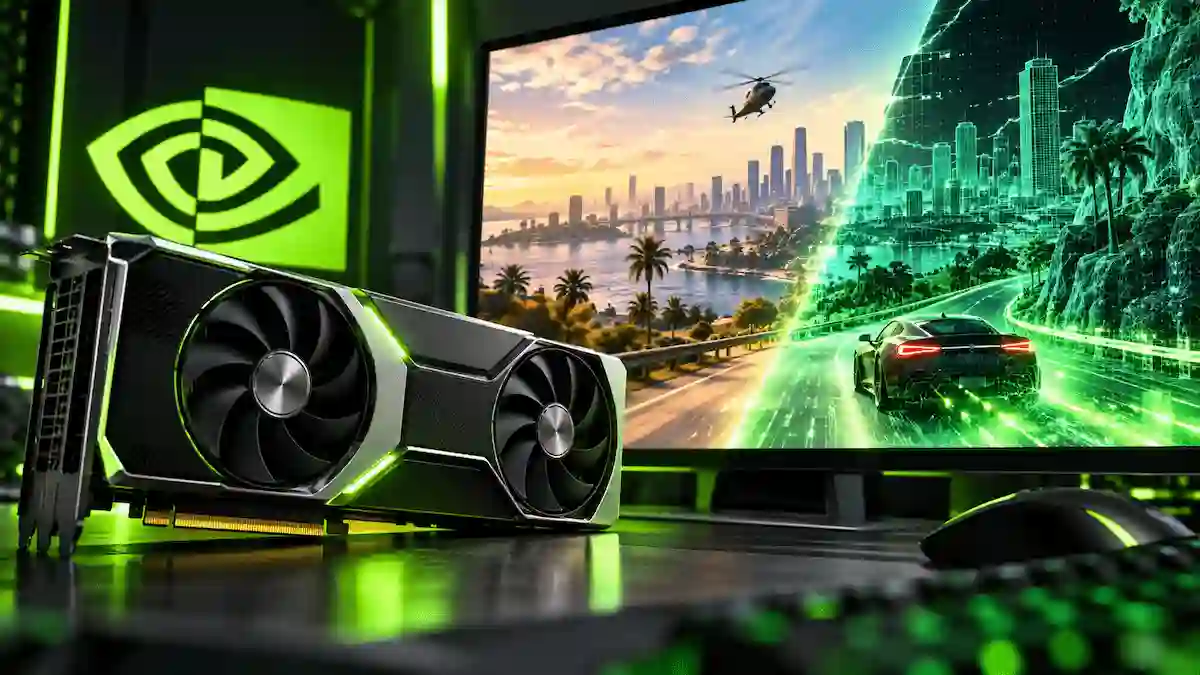
NVIDIA describes DLSS 5 as 3D-Guided Neural Rendering, a technology designed to use information from the game engine to generate more lifelike lighting and material detail while preserving the game’s underlying artistic direction.
That sounds like another graphics upgrade.
It isn’t quite that simple.
The bigger change is that AI is becoming more directly involved in deciding what the final game image should look like.
And that could have major consequences for the next generation of PC games.
NVIDIA DLSS 5 Is Not Just About More FPS
For years, the easiest way to explain DLSS was simple:
Lower the rendering workload, then use AI to reconstruct the image.
That approach made sense because gamers usually wanted two things at the same time:
- Higher image quality
- Higher frame rates
DLSS helped balance both.
But NVIDIA is now pushing neural rendering further.
According to NVIDIA’s developer documentation, DLSS 5 takes the rendered frame from the game engine and uses it as the foundation for neural rendering. The system can then add more realistic lighting and material details using AI.
That creates a very different possibility.
Instead of AI simply helping the GPU reconstruct pixels, AI can become part of the visual pipeline itself.
This matters because modern games are becoming increasingly expensive to render.
Ray tracing and path tracing can create dramatically more realistic lighting, reflections and shadows, but they also require enormous amounts of computational power.
NVIDIA’s answer is increasingly becoming:
Don’t render every visual detail traditionally. Let specialized AI systems help create it.
The First Big Test Is Already Here
DLSS 5 is no longer just a technology announcement.
NVIDIA has already brought the technology to NBA 2K27, making it one of the first real-world demonstrations of the company’s new neural-rendering approach. NVIDIA announced DLSS 5 support for RTX 50 Series GPUs and GeForce NOW.
That is important because technology becomes much easier to understand when gamers can actually see it.
Sports games are also an interesting place to demonstrate neural rendering.
Faces, skin, uniforms, stadium lighting, reflections and material surfaces are all areas where small improvements can become visually obvious.
A football helmet catching stadium light is one thing.
A realistic face under changing arena lighting is another.
That is exactly the type of situation where neural rendering could become noticeable.
The Hidden NVIDIA Advantage
Here is where NVIDIA’s strategy becomes particularly interesting.
DLSS 5 isn’t operating in isolation.
NVIDIA has been building a broader ecosystem around RTX GPUs.
That ecosystem includes:
- DLSS Super Resolution
- Frame Generation
- Multi Frame Generation
- Ray Reconstruction
- Ray Tracing
- Path Tracing
- Neural Rendering
- NVIDIA ACE
- RTX development tools
The result is a much bigger idea:
The GPU is becoming an AI graphics platform rather than simply a traditional graphics processor.
NVIDIA’s recent developer updates also highlight improvements to ACE and other RTX technologies alongside DLSS 5.
This is strategically important for future games.
Developers could increasingly use different AI models for different parts of the gaming experience.
One system could reconstruct pixels.
Another could generate frames.
Another could improve lighting.
Another could power an NPC’s dialogue or behavior.
The GPU becomes the common hardware platform underneath all of it.
But There Is a Catch
DLSS 5 also introduces an important question:
How much AI is too much AI in a video game?
Previous DLSS technologies were relatively easy for gamers to understand.
If a game rendered at a lower internal resolution and reconstructed a sharper image, the basic concept was straightforward.
DLSS 5 is more ambitious.
Because neural rendering can modify visual information beyond simple resolution reconstruction, some gamers are questioning how much control the AI should have over the final image.
That debate isn’t theoretical anymore.
Independent testing and commentary around DLSS 5 have already focused on the trade-off between visual improvements and GPU workload. Some testing has reported substantial performance and power costs in certain scenarios.
So there is a new question for gamers:
Do you want the highest possible frame rate, or do you want the most realistic possible image?
DLSS 5 may eventually make that choice more complicated.
Why RTX 50 Matters
One of the biggest practical issues with DLSS 5 is hardware availability.
At launch, NVIDIA positioned DLSS 5 around its GeForce RTX 50 Series hardware and GeForce NOW.
That creates an obvious divide.
Millions of gamers are still using older RTX hardware.
RTX 30 and RTX 40 owners may reasonably ask:
If my GPU already supports AI acceleration, why can’t I use every new AI feature?
NVIDIA’s newer neural-rendering approach has different hardware and performance requirements, so support is not automatically identical across generations.
Reports indicate NVIDIA has discussed bringing DLSS 5 support to RTX 40-series hardware later, but the company has not provided the same level of immediate availability as RTX 50.
For gamers, that makes future GPU upgrades even more interesting.
The question may no longer be simply:
How many traditional rendering units does this GPU have?
Instead, buyers may increasingly ask:
Which AI graphics technologies can this GPU actually run?
DLSS 5 Could Matter Even More for GTA 6
This is where the story becomes especially interesting for PC gamers waiting for major future releases.
GTA 6 is expected to be one of the most technically demanding games of its generation.
Rockstar’s next open-world game will have to deal with enormous environments, detailed characters, traffic, weather, lighting, reflections and potentially complex simulation systems.
That creates a massive rendering challenge.
However, it is important to separate confirmed information from speculation.
There is currently no basis to state that GTA 6 will use DLSS 5 unless Rockstar or NVIDIA officially confirms it.
But the technology shows where PC graphics are heading.
If future blockbuster games adopt neural rendering more aggressively, technologies like DLSS 5 could become extremely important for achieving higher visual fidelity without requiring every element of a scene to be calculated traditionally.
That could eventually change how developers design games for PC.
NVIDIA Is Also Improving Traditional DLSS
DLSS 5 isn’t the only current NVIDIA graphics story.
NVIDIA recently expanded DLSS 4.5 Ray Reconstruction, which uses a newer transformer-based model to improve image quality in ray-traced and path-traced games. NVIDIA says the updated model brings greater compute capability and processes more parameters while maintaining similar performance to the previous model.
That matters because ray tracing remains one of the biggest workloads in modern games.
NVIDIA is effectively attacking the problem from multiple directions.
Traditional rendering creates the scene.
Ray tracing improves lighting.
DLSS reconstructs and enhances images.
Frame Generation creates additional frames.
Neural rendering adds another layer of visual intelligence.
Each technology addresses a different part of the graphics pipeline.
CONTROL Resonant Shows Where This Is Going
NVIDIA’s latest gaming push also shows how aggressively the company is combining these technologies.
CONTROL Resonant is launching with path tracing and DLSS 4.5 features, including Ray Reconstruction and Dynamic Multi Frame Generation. NVIDIA says RTX 5090 systems can reach up to 380 FPS at 1440p under its specified test configuration.
The important point isn’t simply the benchmark number.
It’s the architecture behind it.
A modern RTX experience increasingly involves multiple layers of acceleration working together.
That’s very different from the old GPU buying conversation, where raw rasterization performance was the primary focus.
NVIDIA’s Bigger Bet Is AI Everywhere
The most interesting thing about DLSS 5 may not actually be DLSS 5 itself.
It may be what comes next.
NVIDIA is clearly betting that AI will become part of almost every major stage of computing.
In gaming, that could mean:
AI-rendered visuals
AI-generated frames
AI-enhanced lighting
AI-powered NPCs
AI voice interaction
AI-assisted animation
AI-driven simulation
NVIDIA’s ACE technology is already moving toward more natural interactions between players and game characters. NVIDIA has highlighted local AI models and voice technologies as part of its broader developer ecosystem.
That means the future gaming PC could be doing much more than drawing polygons.
It could be running a collection of AI systems simultaneously.
The Real Question for Gamers
There is a tendency to judge every new graphics technology by one number:
FPS.
But NVIDIA’s current direction suggests that FPS is becoming only one part of the conversation.
Image quality matters.
Latency matters.
Power consumption matters.
AI capability matters.
Ray-tracing performance matters.
Developer support matters.
And increasingly, the quality of the software stack matters just as much as the hardware itself.
Two GPUs with similar raw specifications could produce very different experiences if one has access to more advanced AI rendering technologies.
That is potentially NVIDIA’s biggest advantage.
Not simply faster hardware.
A deeper software ecosystem built around the hardware.
What Happens Next?
The next major phase will be developer adoption.
DLSS 5 needs more games.
That is the real test.
If developers adopt neural rendering widely and gamers see obvious visual improvements without unacceptable performance costs, the technology could become an important part of PC gaming.
If adoption remains limited, DLSS 5 could remain a specialized feature available in a relatively small number of games.
NVIDIA is already pushing DLSS 4.5, path tracing, RTX technologies and developer tools across a growing list of games. Recent announcements include titles such as 007 First Light, Gears of War: E-Day and CONTROL Resonant.
The direction is clear even if the final destination isn’t.
Final Thoughts
NVIDIA’s biggest gaming move right now isn’t simply another faster GPU.
It is the attempt to make AI part of the graphics pipeline itself.
DLSS 5 represents a major step in that direction.
Instead of asking the GPU to calculate everything traditionally, NVIDIA wants AI to help determine how the final image should be constructed.
That could eventually make highly detailed lighting, materials and environments much easier to deliver at real-time speeds.
But there are trade-offs.
Hardware support is limited at launch. Performance and power costs need to be evaluated on a game-by-game basis. And gamers will continue debating how much AI-generated visual information they actually want in their games.
For NVIDIA, however, the direction is unmistakable.
The company’s future isn’t just about making GPUs faster.
It is about making them smarter.
And if that strategy succeeds, the next generation of PC games may look less like traditional computer graphics—and more like images created by an AI-assisted rendering engine in real time.
That is the real reason NVIDIA DLSS 5 deserves attention.