
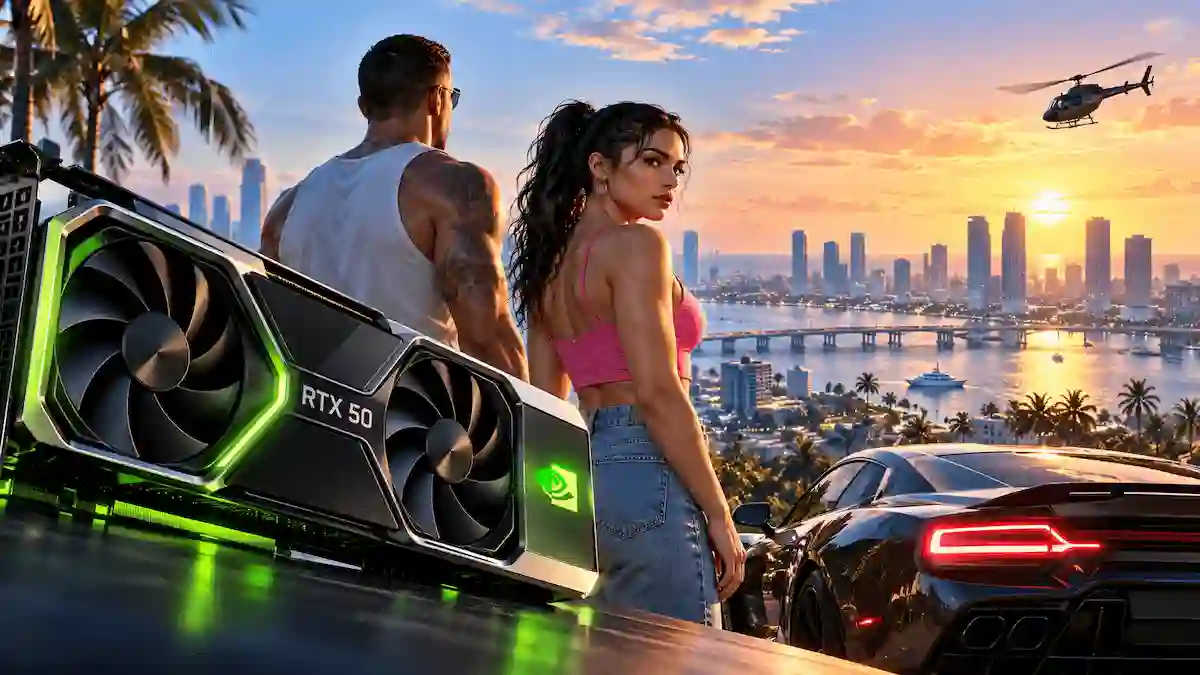
Editor’s note: Rockstar has not yet officially announced GTA 6 PC system requirements or confirmed DLSS support for the PC version. The performance discussion below is therefore based on NVIDIA’s current RTX/DLSS capabilities and what a future PC version could potentially use—not a confirmed GTA 6 feature list. Rockstar currently lists GTA 6 for PS5 and Xbox Series X|S, with a November 19, 2026 release date.
GTA 6 + RTX 50 Could Be About More Than Raw GPU Power
When people talk about GTA 6 on PC, the conversation usually goes straight to one question:
“How powerful will the GPU need to be?”
That is an obvious question.
But it may not be the most interesting one.
The bigger story could be how NVIDIA’s RTX 50-series handles the workload rather than simply how much traditional rendering power the GPU has.
GTA 6 is expected to push enormous amounts of geometry, lighting, reflections, animation, traffic, vegetation, weather effects and world simulation at the same time.
That creates a problem.
Even an extremely powerful GPU can eventually hit a wall when a game tries to render a huge open world at high resolution.
This is where DLSS could become surprisingly important.
NVIDIA currently supports several DLSS technologies across its RTX lineup, while RTX 50-series GPUs have access to additional features such as Dynamic Multi Frame Generation and 3D-guided neural rendering.
And that creates a fascinating possibility for GTA 6:
The RTX 50 advantage may not simply be “more FPS.”
It could be the ability to make the game feel like it is running at a higher performance level than traditional rendering alone would allow.
1. GTA 6 May Be the Perfect Game for DLSS
Think about what makes GTA 6 different from a typical corridor-based game.
The player can potentially move through enormous environments while the engine constantly deals with:
- Cars
- Pedestrians
- Buildings
- Vegetation
- Reflections
- Water
- Weather
- Shadows
- Lighting
- Character animation
- Long-distance geometry
- Streaming assets
- Physics
- AI
The GPU isn’t rendering one small scene.
It is helping create an entire living world.
That makes resolution extremely important.
Rendering native 4K means producing approximately 8.3 million pixels per frame.
At 1440p, that’s about 3.7 million pixels.
The difference is enormous.
DLSS Super Resolution works by rendering internally at a lower resolution and using AI reconstruction to produce a higher-resolution output. NVIDIA describes DLSS as a technology designed to improve performance and image quality on GeForce RTX GPUs.
That could be extremely useful for GTA 6.
Instead of asking the GPU to brute-force every pixel at native 4K, the game could potentially give the GPU a lower internal workload and allow DLSS to reconstruct the final image.
That is the first hidden advantage.
The RTX 50 GPU doesn’t necessarily need to render every final pixel traditionally.
2. The Real Surprise: DLSS Could Protect Visual Quality
There is another reason DLSS could matter.
GTA games are filled with movement.
Cars accelerate.
Characters move.
The camera turns quickly.
Rain falls.
Palm trees move.
Water reflects the environment.
Lights change.
Traffic constantly enters and leaves the player’s view.
These situations are difficult for image reconstruction.
If an upscaler cannot correctly understand what is happening between frames, artifacts can appear.
Hair can shimmer.
Thin objects can flicker.
Fences can become unstable.
Reflections can look strange.
Vegetation can lose detail.
This is where NVIDIA’s AI-based approach becomes particularly interesting.
The goal isn’t simply to make a lower-resolution image bigger.
The technology attempts to reconstruct information intelligently.
That distinction could become important in a game as visually complicated as GTA 6.
3. RTX 50 Has an Advantage Beyond Traditional Rendering
This is where the story becomes more interesting.
The RTX 50-series isn’t simply another generation of conventional GPUs.
NVIDIA’s current DLSS support page shows RTX 50-series support for DLSS Super Resolution, Ray Reconstruction, Frame Generation, Dynamic Multi Frame Generation and 3D-guided neural rendering.
That means NVIDIA is increasingly treating the GPU as an AI rendering platform.
And GTA 6 could potentially benefit from exactly that philosophy.
Imagine the workload like this:
Traditional rendering
GPU → Render frame → Display
But a modern AI-assisted pipeline can look more like:
Game engine → Render information → AI reconstruction → Generated frames → Display
That changes the performance equation.
The GPU isn’t doing everything the old-fashioned way.
4. The Hidden RTX 50 Weapon Could Be Frame Generation
DLSS Super Resolution and Frame Generation are not the same thing.
Super Resolution reduces the amount of rendering required to produce the final image.
Frame Generation attempts to create additional frames between traditionally rendered frames.
That distinction is critical.
Suppose a game is producing 60 traditionally rendered frames per second.
A compatible frame-generation system could potentially increase the displayed frame rate substantially.
However, generated frames don’t magically make the underlying game simulation run at the same rate.
That’s why base FPS and generated FPS should never be treated as identical measurements.
For GTA 6, that distinction could matter enormously.
If the game is GPU-limited because of complex graphics, frame generation could potentially make camera movement appear considerably smoother.
But it won’t eliminate CPU bottlenecks.
And that brings us to one of the biggest questions surrounding GTA 6 PC performance.
5. GTA 6 Could Become a CPU Problem
This is the part many GPU discussions overlook.
GTA 6 isn’t only a graphics problem.
It is also a simulation problem.
A huge open-world game has to manage:
- NPC behavior
- Traffic
- Physics
- Streaming
- Mission logic
- World events
- Pedestrian systems
- Vehicle systems
- Audio
- Animation
- Multiplayer systems
If the CPU cannot prepare frames quickly enough, buying a faster GPU won’t necessarily solve everything.
This is especially important for frame generation.
AI can generate additional visual frames, but it doesn’t replace the underlying game simulation.
So an RTX 5090—or whatever future RTX 50 model a player uses—could theoretically have enormous GPU horsepower while the CPU becomes the limiting factor.
That is why “RTX 50 = GTA 6 at unlimited FPS” would be an oversimplification.
6. DLSS Could Actually Make 4K More Realistic
Here’s the interesting part.
Without reconstruction technology, 4K becomes extremely expensive as visual complexity increases.
But with DLSS, developers can potentially balance:
Image quality + rendering workload + frame rate
instead of sacrificing one completely.
For GTA 6, that could mean a PC player doesn’t necessarily have to choose between:
Ultra graphics at low FPS
and
lower graphics at high FPS.
An optimized DLSS implementation could potentially create another option:
High visual quality + lower internal resolution + AI reconstruction + smoother output.
That’s exactly the kind of workload where AI rendering begins to make sense.
7. Ray Tracing Makes the RTX 50 Question Even More Interesting
Lighting could be one of GTA 6’s biggest graphical challenges.
Reflections, shadows and global illumination can become extremely expensive when ray tracing is involved.
The more rays a game calculates, the more computational work the GPU has to perform.
NVIDIA’s DLSS ecosystem also includes Ray Reconstruction, which is designed to improve ray-traced image reconstruction. RTX 50-series GPUs support it.
If GTA 6 eventually uses advanced ray-tracing techniques on PC, technologies like these could become far more important than simply increasing traditional rasterization performance.
That is why the RTX 50 story may ultimately be about efficiency per visible frame, not just raw teraflops.
8. GTA 6 Could Expose the Difference Between “FPS” and “Smoothness”
This is something PC gamers should watch carefully.
A game showing:
120 FPS
doesn’t automatically mean it feels identical to a game producing 120 native frames.
Frame generation introduces generated images into the presentation pipeline.
The underlying rendered frames and input responsiveness still matter.
That’s why a future GTA 6 benchmark should ideally report:
| Metric | Why It Matters |
|---|---|
| Native FPS | Shows traditional rendering performance |
| DLSS FPS | Shows reconstruction benefit |
| Frame Generation FPS | Shows generated-frame output |
| 1% lows | Shows consistency |
| Frame time | Shows smoothness |
| Input latency | Shows responsiveness |
| VRAM usage | Shows memory pressure |
This would tell us much more than a single FPS number.
9. RTX 50 Could Change the PC Upgrade Conversation
Here’s where things could get interesting for gamers planning a GTA 6 PC.
Traditionally, upgrading meant:
More powerful GPU = more FPS.
But modern GPUs increasingly offer something different.
The upgrade can provide:
More rendering power + more AI capability + better reconstruction + frame generation.
NVIDIA’s current DLSS feature matrix specifically gives RTX 50-series access to technologies that older RTX generations don’t receive, including Dynamic Multi Frame Generation and 3D-guided neural rendering.
That creates a generational difference beyond the normal GPU performance chart.
An RTX 50 GPU may therefore become particularly interesting for games where AI-assisted rendering can offset some of the enormous cost of high-end graphics.
10. But Don’t Buy an RTX 50 GPU Just for GTA 6 Yet
This is probably the most important warning.
GTA 6 PC has not been officially announced by Rockstar in the sources currently available here.
Rockstar’s official GTA 6 platform information currently lists PlayStation 5 and Xbox Series X|S, while the official launch date is November 19, 2026.
There are also no official GTA 6 PC system requirements in those announcements.
So anyone claiming:
“You definitely need an RTX 5090 for GTA 6”
is making a prediction rather than reporting an official requirement.
The same applies to claims that GTA 6 will definitely support DLSS.
It makes technical sense.
It would be logical for a future PC version to support modern upscaling technologies.
But logical does not mean confirmed.
11. GTA 5 Already Shows Rockstar Isn’t Ignoring PC Upscaling
There is, however, an interesting precedent.
Rockstar’s August 2025 GTA V Enhanced update notes added support for FSR and NVIDIA DLSS frame generation technologies on PC.
That doesn’t confirm anything about GTA 6.
But it demonstrates that Rockstar has already implemented modern upscaling/frame-generation technology into its PC ecosystem.
That makes the possibility of advanced reconstruction technology appearing in a future GTA PC release less surprising.
Still, the exact GTA 6 implementation remains unknown.
12. The Bigger Surprise Could Be DLSS + Ray Tracing + Frame Generation Together
Imagine a future GTA 6 PC graphics menu.
You could potentially see options such as:
Resolution: 4K
Ray Tracing: Ultra
DLSS: Quality
Frame Generation: On
Now imagine switching DLSS off.
The GPU suddenly has to render significantly more pixels traditionally.
Ray-traced effects remain expensive.
The workload increases.
Frame rate falls.
Turn DLSS back on.
The GPU renders less internally.
AI reconstruction handles the final image.
Frame generation may add additional displayed frames.
Suddenly the same hardware can produce a dramatically different performance profile.
That’s the hidden advantage.
The RTX 50-series isn’t merely trying to become a faster GPU.
It’s increasingly becoming a GPU that uses AI to decide how much traditional rendering work needs to be done.
13. The Real GTA 6 RTX 50 Question
The question shouldn’t simply be:
“How many FPS will RTX 50 get in GTA 6?”
A much better question is:
“How much of GTA 6’s visual workload can NVIDIA move away from traditional rendering and into AI?”
That could determine the real advantage.
If Rockstar builds GTA 6’s PC version around modern reconstruction technology, RTX 50 GPUs could have a particularly interesting position.
But if the PC version relies heavily on CPU simulation, memory bandwidth and traditional rendering, DLSS won’t solve every performance problem.
That’s why GTA 6 could become one of the most interesting real-world tests of modern AI-assisted graphics.
What We Know vs. What We’re Predicting
| Topic | Current Status |
|---|---|
| GTA 6 | Official |
| PS5 / Xbox Series X|S | Official |
| November 19, 2026 launch | Official |
| GTA 6 PC version | Not confirmed in Rockstar’s cited platform announcement |
| GTA 6 PC requirements | Not officially provided in cited sources |
| GTA 6 DLSS support | Not officially confirmed |
| RTX 50 DLSS capabilities | Official |
| RTX 50 Dynamic Multi Frame Generation | Official |
| RTX 50 Ray Reconstruction | Official |
| GTA V PC DLSS Frame Generation | Officially added |
Rockstar’s official GTA 6 platform information and NVIDIA’s current DLSS documentation support the confirmed portions of this table.
Final Verdict: The “Hidden” Advantage Isn’t Just FPS
GTA 6 could become a fascinating showcase for the RTX 50 generation.
Not necessarily because the RTX 50-series will simply render more pixels than every other GPU.
The more interesting possibility is that AI could change how those pixels are produced in the first place.
DLSS can reduce the traditional rendering workload.
Ray Reconstruction can assist ray-traced image quality.
Frame Generation can create additional displayed frames.
And RTX 50’s newer AI-focused capabilities push that concept even further.
But there is an important line between technical possibility and confirmed GTA 6 features.
Until Rockstar reveals the PC version and its graphics technology, DLSS support remains an expectation rather than a guarantee.
And that may be the biggest reason to watch the GTA 6 PC release closely.
Because if Rockstar combines a massive open-world engine with modern ray tracing and NVIDIA’s latest AI rendering technologies, the biggest GTA 6 graphics revolution may happen behind the scenes—not in the resolution setting.
The surprising part won’t necessarily be that RTX 50 renders GTA 6 faster.
It could be that AI changes what “rendering faster” even means.