
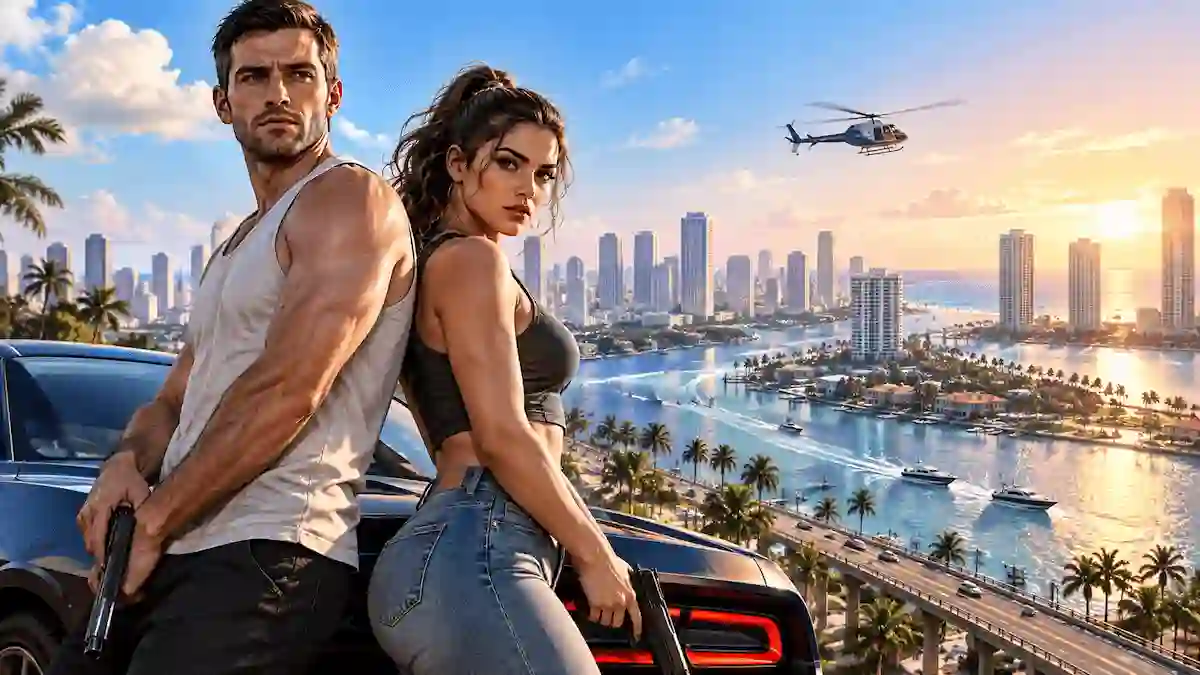
For years, GTA 6 fans have been asking the same questions.
How big is the map?
How realistic will the graphics be?
Will the game run at 60 FPS?
How much better will Vice City look compared with GTA 5?
And, of course, when will the PC version arrive?
Those are all legitimate questions.
But they may not be the biggest challenge facing Grand Theft Auto 6.
The real problem could be something much harder for Rockstar to solve: time itself.
GTA 6 has spent years becoming one of the most anticipated entertainment releases ever. Rockstar has had to build a massive open world while technology, internet culture, social media, memes, trends and even the way people consume entertainment have changed dramatically.
And that creates a strange problem.
How do you create a game that feels modern when the world around it changes faster than a game can be made?
That may be GTA 6’s biggest hidden challenge.
GTA 6 Has Already Lived Through Several Different Eras
The development timeline tells an important story.
Rockstar’s Rob Nelson recently discussed the difficulty of creating satire for a game that has been in development for such a long period. Reporting based on his comments notes that GTA 6 has been in development since 2015, with full-team work increasing after Red Dead Redemption 2.
Think about what changed between 2015 and 2026.
TikTok didn’t exist in its current form.
Generative AI wasn’t part of everyday internet culture.
Social media evolved dramatically.
Memes became faster and shorter-lived.
Smartphones became even more central to everyday life.
Internet personalities became mainstream celebrities.
Entire online trends appeared and disappeared within months.
A joke that was everywhere in 2018 could be completely meaningless today.
That’s a serious challenge for GTA.
Because GTA isn’t simply an open-world action game.
GTA is satire.
Rockstar doesn’t just build cities. It builds exaggerated versions of society.
And society keeps moving.
The Joke Problem
Imagine Rockstar creates a hilarious parody of an internet trend.
The writers work on it.
The animators create the characters.
Voice actors record dialogue.
Artists build environments around it.
Developers implement the mechanics.
QA tests everything.
Then the game launches years later.
Suddenly, nobody remembers the original trend.
That’s the nightmare.
Rockstar has reportedly acknowledged exactly this problem. Nelson explained that the studio has to be careful about what it chooses to satirize because, over such a long development period, something can disappear, change or become dated.
That’s why Rockstar appears to be focusing more heavily on broader cultural themes rather than simply copying whatever meme is popular at the moment.
And honestly, this could make GTA 6 more interesting.
Instead of creating a giant collection of 2026 references, Rockstar has to ask a much harder question:
What will still be funny years from now?
GTA 6 Can’t Just Be “GTA 5, But Bigger”
This creates another problem.
GTA 5 became an enormous cultural phenomenon.
Its online world survived for more than a decade.
That means GTA 6 isn’t entering an empty market.
It’s following one of the most successful open-world games ever made.
Players already know what GTA feels like.
They know the driving.
They know the shooting.
They know the wanted system.
They know the radio.
They know the absurd characters.
They know the open-world formula.
So simply making everything bigger isn’t enough.
A bigger map doesn’t automatically mean a better experience.
More cars don’t automatically create better gameplay.
More NPCs don’t automatically create a more believable world.
More realistic graphics don’t automatically create memorable characters.
Rockstar therefore faces a difficult balancing act.
GTA 6 has to feel familiar enough to be GTA, but different enough to justify being GTA 6.
That’s much harder than simply increasing the resolution.
The World Could Become Too Realistic
This is another fascinating problem.
Rockstar is pushing realism extremely far.
The trailers have shown an unusually detailed version of Vice City and the wider Leonida region. Rockstar describes GTA 6 as the biggest and most immersive evolution of the series yet.
But realism creates expectations.
If a game looks extremely realistic, players start expecting realistic behavior too.
They begin noticing everything.
Why did that NPC disappear?
Why doesn’t traffic react properly?
Why can’t I enter this building?
Why does this crowd behave the same way?
Why does this character repeat the same animation?
Why does this world stop feeling alive when I move away from it?
The closer GTA 6 gets to reality visually, the more obvious its artificial limitations could become.
That’s the paradox.
Better graphics can actually make imperfections easier to notice.
The “Living World” Problem
This may be one of the most important things to watch after launch.
GTA has always sold players the fantasy of freedom.
But GTA 6 appears to be taking the living-world concept much further.
That means players will probably spend a huge amount of time simply observing the world.
Not completing missions.
Not following the story.
Just walking around.
Driving.
Watching NPCs.
Exploring beaches.
Visiting businesses.
Following random events.
Looking for strange interactions.
And that’s where Rockstar’s enormous attention to detail becomes both its greatest strength and its biggest burden.
Players will test the world.
They will deliberately try to break it.
They’ll drive into unusual locations.
They’ll manipulate NPCs.
They’ll search every corner.
They’ll experiment with physics.
They’ll discover systems Rockstar never advertised.
And when something doesn’t work, the internet will find it within hours.
That’s the modern gaming environment.
Social Media Makes GTA 6 Harder to Control
GTA 5 launched in a very different internet environment.
Today, every interesting discovery can become a viral video almost instantly.
A funny NPC interaction?
TikTok.
A strange physics bug?
YouTube Shorts.
An unexpected mission detail?
Reddit.
A hidden animation?
X.
A massive gameplay discovery?
Millions of views.
This means GTA 6 won’t simply be consumed.
It will be dissected.
Players will pull the game apart.
They’ll compare it frame-by-frame with trailers.
They’ll compare NPC behavior.
They’ll analyze physics.
They’ll inspect animations.
They’ll look for cut content.
They’ll compare different versions.
And they won’t wait months to do it.
They’ll start on launch day.
That creates enormous pressure.
Then There Is the GTA 5 Shadow
Here’s something even more difficult.
GTA 5 isn’t disappearing.
GTA Online continues to exist, and Take-Two has repeatedly identified GTA Online and GTA V among its major contributors.
That means GTA 6 has to launch into a world where millions of players already have years of investment in GTA 5.
They have characters.
They have cars.
They have properties.
They have businesses.
They have friends.
They have memories.
They have routines.
GTA 6 therefore isn’t just competing with other games.
In some ways, it is competing with GTA 5 itself.
That’s a strange position for a sequel.
The Online Question Could Be Even Bigger
And then comes GTA Online.
Rockstar has confirmed that GTA 6 will launch on PS5 and Xbox Series X|S, with the current official release date set for November 19, 2026.
But the long-term question is bigger than launch day.
How does Rockstar turn Leonida into another decade-long platform?
That’s the real challenge.
GTA Online became much more than a multiplayer mode.
It became an evolving ecosystem.
GTA 6’s online component will therefore face enormous expectations.
Players won’t simply ask:
“Is the multiplayer fun?”
They’ll ask:
“Can this world keep me interested for years?”
That’s a completely different challenge.
The PC Question Adds Another Layer
There’s another elephant in the room.
The currently announced platforms are PS5 and Xbox Series X|S. Rockstar and Take-Two’s current official materials do not list PC as a launch platform.
That matters because the PC audience has a completely different set of expectations.
PC players will eventually want higher resolutions.
Higher frame rates.
Advanced graphics settings.
Ray tracing options.
Mods.
Ultra-wide support.
And potentially technologies such as advanced upscaling.
But the more technically ambitious GTA 6 becomes, the more complicated a future PC version could be.
That doesn’t mean a PC version is impossible.
It simply means the technical expectations surrounding one could be enormous.
The Biggest Risk: Expectations
And now we reach the real problem.
GTA 6 may not be fighting another game. It may be fighting the version of GTA 6 that exists inside people’s heads.
That’s much harder.
Fans have had years to imagine what the game could become.
Some expect a revolutionary physics system.
Others expect an enormous map.
Others want an incredibly detailed simulation.
Some expect GTA 6 to completely redefine open-world gaming.
Some expect GTA Online 2 to last another decade.
Some expect PC technology to transform the game later.
And some simply expect Rockstar to deliver something they have never experienced before.
No game can perfectly satisfy every imagined version of itself.
That’s the danger.
Why the Long Development Cycle Could Actually Matter
A long development cycle gives Rockstar more time to build details.
But it also creates another problem.
The target keeps moving.
A feature that seemed revolutionary several years ago may feel normal today.
A graphical technique that looked unbelievable during early development may become standard by launch.
A social trend can disappear.
A cultural joke can become outdated.
A gameplay mechanic can be copied by competitors.
This is exactly why Rockstar’s recent comments about avoiding overly temporary satire are important. The studio knows that GTA 6 needs cultural references that can survive the game’s unusually long production cycle.
The goal isn’t necessarily to make GTA 6 feel like 2026.
The goal may be to make it feel like a world that represents this era without becoming trapped inside it.
That’s a much smarter challenge.
Rockstar’s Solution May Be Simplicity
Ironically, the solution could be going backward.
Instead of chasing every meme, Rockstar can focus on things that don’t disappear.
Ambition.
Greed.
Celebrity culture.
Consumerism.
Crime.
Social media obsession.
Money.
Status.
Relationships.
Power.
These ideas don’t become outdated easily.
The technology changes.
The memes change.
The apps change.
But people don’t suddenly stop caring about money, fame or status.
That’s where GTA’s satire has always had its advantage.
Rockstar doesn’t need to predict the future.
It needs to understand human behavior.
GTA 6 Doesn’t Need to Predict 2030
This is perhaps the most important point.
GTA 6 doesn’t have to perfectly represent every aspect of modern society.
It needs to create a believable fictional world.
If Rockstar tries too hard to include every current trend, the game could age quickly.
But if it builds a world around timeless human behavior, the opposite can happen.
GTA 6 could become more interesting with age.
That’s what happened with older GTA games.
Players return years later and discover jokes, references and social commentary that still work even though the technology looks old.
That’s the standard GTA 6 has to reach.
The Final Twist
So when GTA 6 launches on November 19, 2026, the biggest question shouldn’t simply be:
“How good does it look?”
It should be:
“Does this world feel alive enough to survive the next ten years?”
Because Rockstar isn’t just making another blockbuster.
It’s building a world that could potentially become the foundation for years of stories, updates, online content and player discoveries.
And that’s why the hidden problem isn’t necessarily the map.
It isn’t necessarily performance.
It isn’t necessarily graphics.
It isn’t even necessarily the PC version.
The biggest challenge is making a massive, expensive, long-developed world feel current without making it disposable.
Rockstar has already spent years building Leonida.
Now it has to make sure Leonida doesn’t feel like a snapshot of a world that disappeared the moment GTA 6 arrived.
That’s the real test for GTA 6.
And perhaps the most interesting thing is that players won’t know whether Rockstar solved it until they finally step into Vice City themselves.