
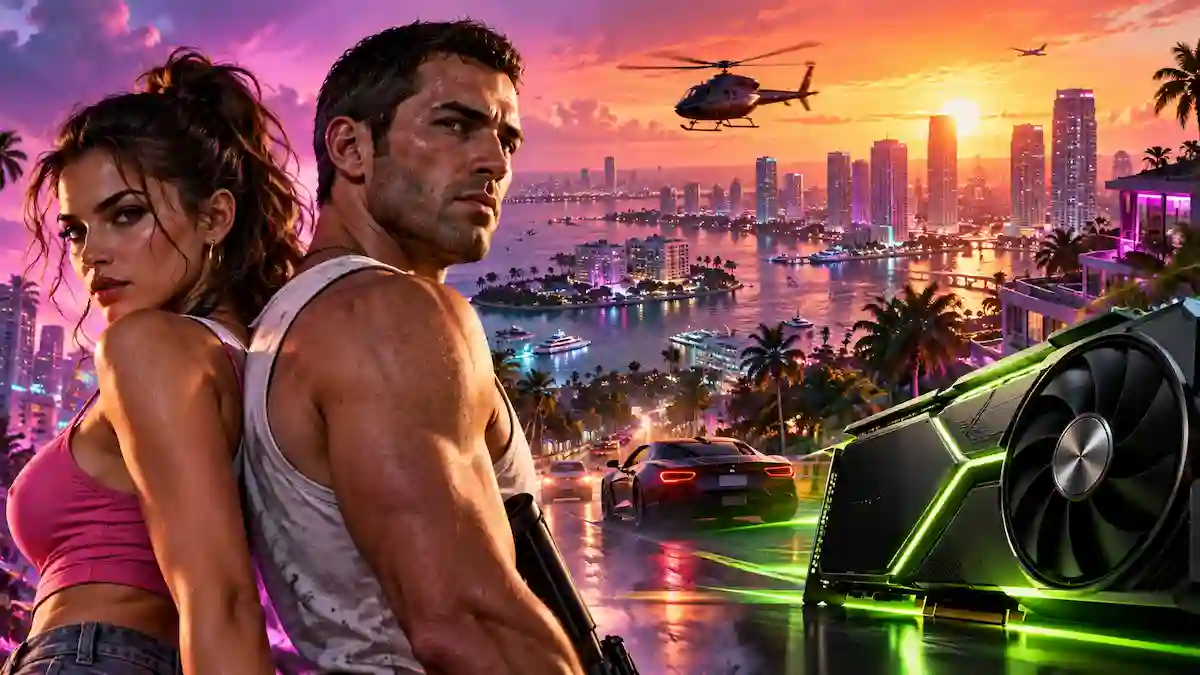
For years, NVIDIA DLSS has been about one simple promise: make games run faster without making them look worse.
But DLSS 5 changes that idea.
The latest generation is no longer focused only on reconstructing pixels, generating frames, or improving ray-traced lighting. NVIDIA‘s new 3D-Guided Neural Rendering is designed to become a final stage in the graphics pipeline, using AI to add realistic lighting and material detail to an already-rendered game frame.
And that creates an interesting question for GTA 6.
Could DLSS 5 eventually become one of the most important technologies behind the PC version of GTA 6?
There is no official answer yet.
Rockstar has not announced a PC version of GTA 6, and it has not confirmed DLSS 5 support. Its current official platform information lists PlayStation 5 and Xbox Series X|S.
So this isn’t a story about NVIDIA secretly confirming GTA 6 support.
It’s about something more interesting.
The technology NVIDIA is building now could be exactly the kind of technology a future GTA 6 PC version could benefit from.
And the reason goes much deeper than FPS.
DLSS 5 Is Not Just Another FPS Feature
To understand the GTA 6 connection, you first need to forget what DLSS traditionally means.
Older versions of DLSS primarily focused on reconstructing images from lower-resolution data.
Then NVIDIA expanded the technology.
DLSS started handling features such as:
- Super Resolution
- Frame Generation
- Ray Reconstruction
- Multi Frame Generation
DLSS 4.5 pushed this even further with Dynamic Multi Frame Generation and an updated Transformer-based approach.
DLSS 5 takes another step.
Instead of simply asking:
“How can AI make this frame cheaper?”
NVIDIA is effectively asking:
“How can AI make this frame look more realistic?”
That’s a much bigger change.
NVIDIA describes DLSS 5 as a 3D-Guided Neural Rendering stage that can add lifelike lighting and material details while remaining grounded in information supplied by the game engine.
That distinction matters enormously for an open-world game.
And that’s where GTA 6 becomes interesting.
GTA 6 Is Already Trying to Push Visual Realism
Rockstar’s next Grand Theft Auto isn’t simply trying to make a larger map.
The trailers and gameplay material have emphasized realistic characters, environments, weather, lighting, reflections and dense scenes.
That creates an obvious problem for PC hardware.
An enormous open world has to render:
- Characters
- Vehicles
- Buildings
- Roads
- Vegetation
- Water
- Reflections
- Shadows
- Weather
- Lighting
- NPCs
- Traffic
- Physics
- Animation
And all of that has to happen while the player is moving through the world.
That’s where AI rendering could become particularly interesting.
Imagine driving through Vice City at night.
Rain is falling.
Street lights reflect from wet roads.
Neon signs illuminate nearby vehicles.
Jason or Lucia walks underneath different light sources.
The windshield has water droplets.
Hundreds of objects are visible simultaneously.
Traditional rendering has to calculate an enormous amount of information.
A neural rendering system could potentially help enhance how those materials and lighting effects appear after the traditional rendering stage.
That’s essentially the direction NVIDIA is taking with DLSS 5.
But Here’s the Important Part: NVIDIA Isn’t Generating GTA 6
This is where the internet could easily misunderstand the technology.
DLSS 5 isn’t a magic button that tells AI:
“Create GTA 6.”
NVIDIA’s system is specifically designed to remain grounded in the game engine’s rendered output.
The engine provides information such as the rendered frame and motion vectors, while the neural rendering stage enhances the final appearance. NVIDIA says the system is designed to preserve scene structure, character identity and artistic intent.
That’s important.
Rockstar would still create:
- The characters
- The vehicles
- The buildings
- The animations
- The textures
- The world
- The lighting setup
- The gameplay
DLSS 5 would potentially sit much later in the pipeline.
Think of it like this:
Rockstar creates the world.
The game engine renders the world.
DLSS 5 could potentially enhance how that rendered world appears on your screen.
That’s a very different concept from AI simply inventing graphics.
The GTA 6 Connection Nobody Can Confirm Yet
Here’s where we need to slow down.
There is currently no official confirmation that GTA 6 will support DLSS 5.
There isn’t an NVIDIA announcement saying:
“GTA 6 is coming with DLSS 5.”
There isn’t a Rockstar announcement saying it either.
So claiming that DLSS 5 is definitely coming to GTA 6 would be speculation.
However, the technology’s capabilities make the possibility worth watching.
NVIDIA says DLSS 5 is designed to run locally on GeForce RTX 50 Series GPUs, with support for real-time rendering at up to 4K.
That means the conversation around a future GTA 6 PC version could eventually become much more interesting than:
“How many FPS can my GPU get?”
It could become:
“How realistic can the game actually look?”
Why GTA 6 Could Be a Perfect Test Case
GTA is different from many games because players don’t spend their entire time staring at one carefully controlled environment.
You’re constantly moving.
You can turn a corner.
Drive from a sunny beach into a darker street.
Enter a building.
Walk into a nightclub.
Drive during a storm.
Look at the ocean.
Switch characters.
Move from one part of the map to another.
That means the rendering system has to deal with constantly changing conditions.
NVIDIA says DLSS 5 is designed around a one-frame-in, one-frame-out process and uses engine motion vectors to maintain temporal stability.
For an open-world game, that characteristic could be particularly valuable.
The technology isn’t supposed to randomly change the image every frame.
It is designed to understand how the current rendered frame relates to movement and scene information.
That doesn’t guarantee GTA 6 compatibility.
But technically, it’s an intriguing match.
The Secret Weapon Might Be Materials
Lighting gets most of the attention.
But materials could be the bigger story.
Think about GTA 6’s world.
You have:
Wet asphalt.
Painted cars.
Metallic surfaces.
Glass.
Skin.
Clothing.
Leaves.
Concrete.
Water.
Wood.
These materials react differently to light.
NVIDIA specifically describes DLSS 5 as being able to enhance lighting and material detail.
That could potentially make a scene feel more realistic without requiring developers to manually simulate every tiny visual detail at extreme computational cost.
And GTA 6 is exactly the kind of game where tiny improvements can have a huge cumulative effect.
A single street may contain hundreds of surfaces.
Multiply that across a massive open world.
Suddenly, neural rendering becomes much more interesting.
NVIDIA Is Also Giving Developers More Control
This may be the most important part of DLSS 5.
NVIDIA isn’t presenting it as an uncontrolled AI filter.
Developers can control how the system behaves.
According to NVIDIA’s developer documentation, studios can select different models, adjust Structure Intensity and Tone Intensity, and use semantic or engine-level masks to determine where the effect should apply.
That means developers could potentially decide:
Enhance this environment.
Don’t modify this character’s face.
Apply the effect to foliage.
Reduce the effect on specific objects.
Use a different look during cinematics.
This level of control could be particularly important for Rockstar.
Why?
Because Rockstar has a very recognizable visual style.
The goal wouldn’t necessarily be to make GTA 6 look like a generic AI-generated video.
The goal would be to preserve Rockstar’s art direction while potentially increasing visual realism.
And There Is One Big Catch
DLSS 5 isn’t free.
Neural rendering requires GPU resources.
And NVIDIA currently positions DLSS 5 for GeForce RTX 50 Series GPUs.
That immediately creates a hardware question.
If GTA 6 eventually arrives on PC, players will have completely different GPUs.
Some will have high-end RTX cards.
Others will be using older hardware.
Some will prioritize 1440p.
Others will want 4K.
Some will want maximum graphics.
Others simply want stable performance.
So even if Rockstar eventually supports DLSS 5, that doesn’t mean every PC gamer will use it.
It would likely become another option within a much larger graphics menu.
The First Real Proof Already Exists
DLSS 5 isn’t theoretical anymore.
NVIDIA launched the technology with NBA 2K27, making it the first officially supported game. NVIDIA says DLSS 5 enhances lighting and materials while preserving the game’s underlying scene and character information.
That gives gamers an important preview.
But GTA 6 would be a completely different challenge.
NBA 2K27 controls its environments much more tightly.
GTA 6 is an enormous open-world sandbox.
If Rockstar eventually adopts the technology, its implementation would be much more interesting to watch because of the game’s constantly changing environments.
What About the GTA 6 PC Release?
For now, this is still the biggest unanswered question.
Rockstar’s current official GTA 6 platform information lists PS5 and Xbox Series X|S.
So there is no official PC release date to point to.
That also means there is no official DLSS 5 specification for GTA 6.
This is important because PC gamers shouldn’t start buying hardware based solely on the assumption that GTA 6 will support a particular NVIDIA feature.
Wait for official information.
But keep watching the technology.
Because the longer NVIDIA develops neural rendering, the more interesting the eventual GTA 6 PC conversation could become.
Could DLSS 5 Change GTA 6 More Than Frame Generation?
Possibly — if Rockstar supports it.
That’s the key qualification.
Frame Generation changes performance perception by creating additional frames.
DLSS 5 is attempting something different.
It could change the appearance of the frame itself.
That’s a much more visually obvious concept.
Imagine two versions of the same GTA 6 scene.
One uses traditional rendering.
The other uses neural rendering to enhance lighting and materials.
The difference might not be:
60 FPS vs 100 FPS.
It could instead be:
“Why does this scene look more alive?”
That’s what makes DLSS 5 particularly interesting.
The Bigger GTA 6 Question
The biggest question isn’t actually:
“Will GTA 6 support DLSS 5?”
It’s this:
How far will Rockstar allow AI to influence the final image?
Rockstar has spent years building its own visual identity.
DLSS 5 introduces a new layer between the traditional renderer and what the player finally sees.
NVIDIA says developers remain in control through model selection, intensity controls and masking.
If Rockstar ever embraces the technology, that control could become extremely important.
Because GTA 6 doesn’t just need to look realistic.
It needs to look like GTA.
What We Know vs What We Don’t
| Question | Current status |
|---|---|
| Is DLSS 5 real? | Yes |
| Is DLSS 5 available in a game? | Yes — NBA 2K27 |
| Does DLSS 5 enhance lighting/materials? | Yes |
| Does it use game-engine information? | Yes |
| Is it designed for RTX 50 Series? | Yes |
| Is GTA 6 confirmed for PC? | No official confirmation currently |
| Is DLSS 5 confirmed for GTA 6? | No |
| Could the technology benefit a future GTA 6 PC version? | Potentially |
The distinction between the last two points is crucial.
Final Verdict: The Real DLSS 5 Mystery
NVIDIA isn’t hiding a secret GTA 6 announcement.
At least, there is no public evidence of one right now.
The more interesting story is what NVIDIA is quietly changing about PC graphics.
DLSS started as a way to make games faster.
Now NVIDIA wants AI to help determine how realistic the final image can look.
That’s a major shift.
And if GTA 6 eventually comes to PC, a game built around massive environments, detailed characters, dynamic weather, vehicles, water, glass, vegetation and constantly changing lighting could become one of the most fascinating tests for this technology.
But for now, one thing remains unanswered:
Will Rockstar actually let DLSS 5 touch the final pixels of GTA 6?
Until Rockstar or NVIDIA officially confirms it, everything beyond that is speculation.
And honestly, that’s what makes the GTA 6 + DLSS 5 story so interesting right now.
The technology exists.
The hardware exists.
The first DLSS 5 game exists.